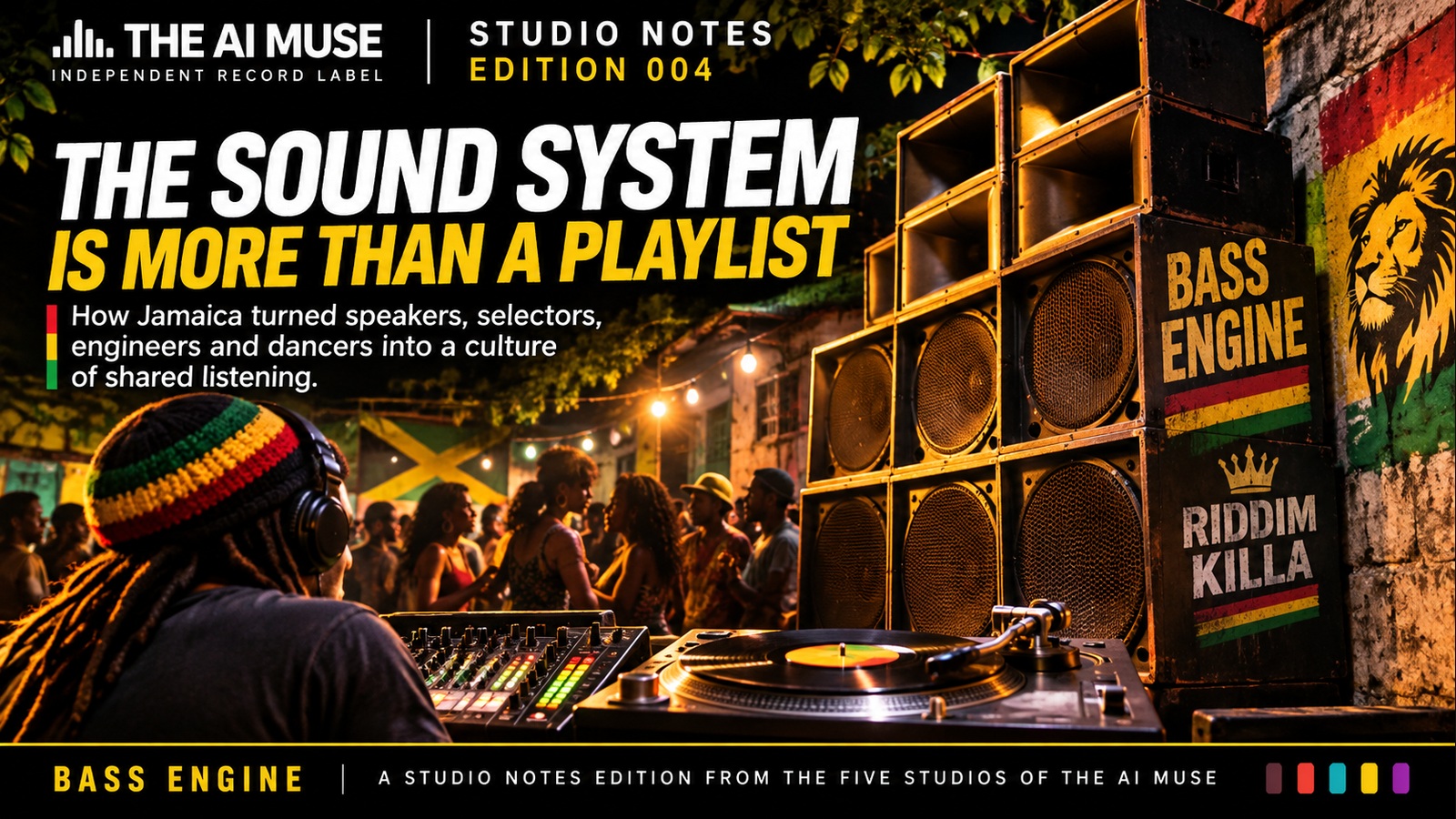
A playlist organizes recordings. A sound system organizes an experience.
The distinction matters.
A playlist can travel anywhere, following a listener from a train to a kitchen to a late-night walk. A Jamaican sound system, in its original cultural setting, brought people together around the physical force of recorded music. Speakers, amplifiers, turntables, selectors, microphone performers and dancers became parts of one musical event.
The recording was not the whole experience. What happened around it mattered just as much.
Before the music became an industry
In postwar Kingston, sound systems offered a way to experience music publicly, particularly for communities with limited access to established entertainment venues.
Mobile equipment transformed streets and yards into places where people could gather, dance and hear records at extraordinary volume.
Early systems played imported American rhythm and blues. As Jamaican recording developed, the music shifted toward local sounds, including ska, rocksteady and eventually reggae.
The Museum of Arts and Design traces this development to early-1950s Kingston and describes the relationship between sound systems and Jamaica's changing social conditions.
The important innovation was not simply bigger speakers. It was a different relationship between performers, recorded music and the public.
The selector understood the room
In sound-system culture, the selector was more than somebody choosing the next record.
Selection required judgment: reading the audience, managing energy, recognizing when to change direction and understanding which recording belonged at which moment.
The deejay, in Jamaican terminology, often performed vocally over the music, rather than necessarily operating the turntables. That distinction is important when discussing the culture accurately.
The sound system made listening responsive. A recording could be tested against the immediate reaction of the crowd.
The dance became a place where musical ideas could succeed, fail or develop.
Competition created innovation
Sound systems competed for audiences, reputation and distinctive records.
Figures including Clement “Coxsone” Dodd and Duke Reid became central to the culture's development. Their involvement extended beyond presenting music into recording and production.
Competition encouraged exclusive selections, distinctive sound and technical experimentation. The sound-system environment helped shape the infrastructure through which Jamaican popular music developed.
It also changed what a recording could be.
Rather than a fixed product heard identically every time, a track could exist in different versions, arrangements and performance contexts.
That idea would become especially significant in dub.
When the mixing desk became an instrument
King Tubby, born Osbourne Ruddock, helped establish dub as a creative approach to recorded sound.
By emphasizing rhythm sections, removing or reducing vocals, and manipulating echo, reverb and equalization, engineers could transform existing recordings into new listening experiences.
The mixing desk became a performance tool.
King Tubby's work is especially important because it demonstrated that the engineer's decisions could be central to the artistic identity of a recording, rather than merely technical support.
That influence extends into later approaches to remixing, bass music and electronic production.
But the original Jamaican innovators deserve their own historical recognition, rather than being valued only because other genres later borrowed from their work.
The people behind the bass
The history of Jamaican sound is also the history of singers, musicians, producers, engineers, selectors and communities.
Scientist, the professional name of Hopeton Overton Brown, became a prominent dub engineer through work associated with King Tubby's studio and later Jamaican recording facilities.
His work illustrates how mixing itself could carry a distinctive artistic signature.
These contributions should not disappear behind simplified stories about genres or technology.
Nor should the audience disappear.
The dancers and listeners helped make the sound system culturally meaningful. Without them, the equipment was simply equipment.
A living culture, not a museum exhibit
In 2018, UNESCO inscribed reggae music of Jamaica on its Representative List of the Intangible Cultural Heritage of Humanity.
The recognition acknowledged reggae's continuing role in social commentary, cultural expression and communal life.
That recognition should not be mistaken for an instruction to freeze the music in one historical period.
Reggae, dancehall and related forms continue to evolve.
New technologies, production methods and audiences can participate in that evolution while remaining accountable to the people and cultures that developed the foundations.
Inside Bass Engine
Within The AI Muse independent record label, Bass Engine is the Studio dedicated to dancehall, reggae and lovers rock, with Riddim Killa as its resident artist.
Its creative promise is movement.
That does not mean every recording must be fast or aggressive. Movement can come from bass pressure, syncopation, a vocal phrase, a change in rhythm or the emotional shift of a late-night lovers-rock selection.
The Studio's Bass Engine — Reggae, Dancehall & Lovers Rock playlist provides a contemporary listening destination for this range of influences.
Bass Engine is not being presented as an originator of Jamaican sound-system culture, nor as a substitute for the musicians who built it.
It is a contemporary creative project working with musical traditions that have their own history, authorship and cultural significance.
The difference between hearing and gathering
Digital playlists make music accessible in ways earlier generations could scarcely have imagined.
But convenience is not the same thing as participation.
The sound-system tradition reminds us that music can create a temporary public space. People bring their bodies, expectations, memories and reactions into the experience.
A selector listens to the crowd. The crowd responds to the recording. The recording changes meaning in the room.
The music becomes something people make together, even when it begins as sound pressed onto a record.
A playlist can tell you what comes next.
A sound system asks what happens when everybody hears it.
From the Bass Engine catalogue
Explore reggae, dancehall and lovers rock through The AI Muse's Bass Engine playlist, featuring the Studio's contemporary listening catalogue.
Listen to Bass Engine — Reggae, Dancehall & Lovers Rock